
Scripture and Ethics (and Wesley) (3)
Reading with John Wesley

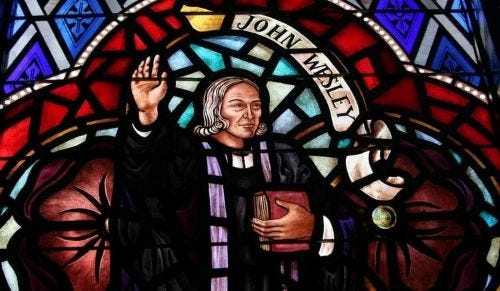
In part one of this four-part series, I mapped something of the contemporary conversation on Scripture and Christian ethics. Part two focused on the way modern biblical studies has exacerbated the troubled relationship between the Bible and ethics, with the wide gulf it posts between then and now. Here I ask: What does John Wesley bring to the conversation?
Wesley’s work at the interface of Scripture and ethics is interesting from a variety of perspectives. It is easy to see how those in the Wesleyan and methodist traditions might share an insider’s interest in Wesley, but his work is attractive more generally. This is because he lived at the momentous turn of an era, with feet planted in both premodern and modern sensibilities.1
Wesley: Premodern//Modern, Not Precritical
Of course, modern assessment of Wesley as a reader of the Bible has sometimes relegated his work to the category of the “precritical” or “uncritical,”2 often drawing attention to Wesley’s lack of attention to such standard interests of the historical-critical paradigm as the “singular” or “original meaning” of a biblical text. This characterization of Wesley is mistaken on at least three grounds.
First, the term itself, precritical, is a dismissive anachronism that has gained its force from the assumption that the only legitimate reading of a biblical text is a modern one. C. S. Lewis referred to this false belief as “chronological snobbery,” noting that this form of “presentism” assumes that modern ideas are superior simply because they are modern.
Second, in fact, the “critical tradition” includes a wider range of approaches than modern criticism usually recognizes. Some interpretations try to imitate reality (mimetic), others focus on practical effects (pragmatic), some highlight personal expression (expressive), and others aim to be neutral or factual (objective). Each finds the locus of meaning in its own place—in “the universe,” in “the work,” in “the artist,” or in “the audience”—and so each in its own way is “critical” insofar as it is concerned with evaluating competing interpretations.3
Third, “precritical” or “uncritical” overlooks the degree to which Wesley himself participated in the Enlightenment project—assigning significance to Reason in his theological enterprise, for example, and evaluating various readings of Scripture in relation to the findings of the New Science that emerged in the seventeenth century.
Wesley’s Faith-full Approach
Study of Wesley as a “Bible scholar” demonstrates his ability to navigate what in the ensuing centuries would seem to be competing, even contradictory, interests. On the one hand, familiarity with Wesley’s Explanatory Notes upon the New Testament reveals his interest in the importance of historical and linguistic observations in making sense of the Bible. His comments reflect his concern with the historical background that would become a characteristic feature of modern biblical studies.
This essay resumes after these book recommendations. [Note: As an Amazon Associate, I may earn a small commission if you click through and make a purchase. This doesn’t affect the price you pay and helps support this website.]

Thomas C. Oden, Ethics and Society, vol. 4 of John Wesley’s Teachings (Grand Rapids: Zondervan, 2014). ISBN: 9780310587187. 336 pp.
Oden provides a convenient, systematic guide to Wesley’s moral vision, emphasizing how his theology of grace shapes character and social responsibility. Oden organizes Wesley’s scattered writings into four main sections—social, economic, political, and theological ethics—showing how Wesley grounds concrete practices in Scripture, tradition, and pastoral experience. He highlights Wesley’s concern for holiness formed in small, accountability-focused gatherings, his practical teaching on (e.g.) money and work, and his opposition to slavery and exploitation as expressions of Christian love.

Manfred Marguardt, John Wesley’s Social Ethics: Praxis and Principles (Nashville: Abingdon, 1992). ISBN: 9780687204946. 205 pp.
Marquardt’s modern classic studies how Wesley’s theology embraces concrete social action, with Scripture playing a central role in shaping that ethic. He shows that Wesley constantly appeals to biblical texts—especially Paul and James—to justify an ethic of responsibility and solidarity, weaving justification by faith and the necessity of good works into a coherent social‑justice vision. He traces how Wesley uses Scripture to oppose slavery, critique wealth, and defend the poor, as well as highlights how Wesley reads the Bible in conversation with tradition and reason, so that Scripture both authorizes social action and shapes the character and communal discipline of Methodists. The result is a portrait of Wesleyan ethics as biblically rooted, theologically dense, and personally transformative.
On the other hand, in the “Preface” to his Sermons on Several Occasions, Wesley bears witness to a decidedly unmodern approach to dealing with difficult texts. “Does anything appear dark or intricate?” he asks. For many of us and our contemporaries, the key to making sense of difficult passages in the Bible is to seek more background, more historical detail, more insight into ancient patterns of behavior. Wesley takes a different path.
Does anything appear dark or intricate? I lift up my heart to the Father of lights: ‘Lord, is it not your Word, “If any lack wisdom, let them ask of God”? You “give generously and ungrudgingly.” You have said, “If any be willing to do your will, they shall know.” I am willing to do, let me know, your will.’ I then search after and consider parallel passages of Scripture, ‘comparing spiritual things with spiritual.’ I meditate thereon, with all the attention and earnestness of which my mind is capable. If any doubt still remains, I consult those who are experienced in the things of God, and then the writings whereby, being dead, they yet speak. And what I thus learn, that I teach. (§5)
Faced with a biblical text that is unclear, Wesley
Looks to God for help,
Compares the text with other biblical passages,
Meditates,
Consults with “those who are experienced in the things of God,” and
Looks to commentaries and other published works for assistance.
This is not to suggest that, for Wesley, historical detail was unimportant. In a stinging reversal of much modern biblical interpretation, though, Wesley operates with the assumption that the chief chasm that must be overcome if we are to make sense of Scripture is not measured in terms of our need for more historical detail but in terms of our need to know God and God’s ways. “I lift up my heart to the Father of lights.... I am willing to do, let me know, your will.”
Without wanting to downplay the importance of prayer and theological formation, we should also note that anyone wanting to be schooled in reading the Bible with Wesley must do so by taking advantage of the tools available for doing so. Wesley insisted on using the biblical languages, and his biblical studies demonstrate the baseline importance of a wide range of interpretive approaches available to serious readers of the Bible in the 1700s. (See, e.g., Augustus Herman Franck, A Guide to the Reading and Study of the Holy Scriptures.)
In other words, Wesley’s approach to Scripture cannot be characterized as emphasizing prayer over doing research, nor doing research over prayer. He held these together, while obviously prioritizing the significance of Scripture for Christian faith and life over the importance of establishing the singular, first-century meaning of a text. It is for this reason that Wesley might look askance at how, under the influence of the historical-critical paradigm, we have problematicized the relationship between Scripture and Christian ethics.
For Wesley, we might say, the tools and methods of biblical scholarship are only means to the end of Christian faithfulness—measured in terms of orthodoxy (right thinking), orthopraxis (right behavior), and orthokardia (right-heartedness).

Case Study: “On Dress”
Consider Wesley’s treatment in his sermon “On Dress” of 1 Peter 3:3–4:
“Don’t try to make yourselves beautiful on the outside, with stylish hair or by wearing gold jewelry or fine clothes. Instead, make yourselves beautiful on the inside, in your hearts, with the enduring quality of a gentle, peaceful spirit. This type of beauty is very precious in God’s eyes.”
To a degree difficult to fathom today, in the first-century Roman world, a person was his or her clothing—that is, what people wore paraded their character and status in the community. Clothing symbolized reality. Thus, Klaus Berger can observe, “In the ancient context a person’s fundamental relationships are rendered effective by the clothing that one wears, which in turn means that clothing shapes the quality of one’s life.”4 As Shakespeare would later put it, “For the apparel oft proclaims the man” (Hamlet, Act 1, Scene 3). As a result, a variety of first-century documents, including legal materials and philosophical writings, concerned themselves with proper dress.
Writing in the mid-first century, for example, Seneca, philosopher and statesman, praised his mother with these words:
Unchastity, the greatest evil of our time, has never classed you with the great majority of women. Jewels have not moved you, nor pearls.... You have never defiled your face with paints and cosmetics. Never have you fancied the kind of dress that exposed no greater nakedness by being removed. Your only ornament, the kind of beauty that time does not tarnish, is the great honor of modesty. (Ad Helv. 16.3-5)
Accordingly, the items that Peter lists—stylish hair, gold, and fine clothing—would have put on display for all to see such character qualities as lack of self-control, immodesty, and snootiness. Against eye-catching fashion, he sets a heart that pleases God.
Without taking Wesley’s audience on a guided tour of striking fashion on the streets of first-century Asia Minor, Wesley’s sermon nevertheless performs a similar task. After affirming the neatness of dress and overall good grooming, Wesley answers the question: What do we display by our fine clothes and costly jewelry? Here begins an annotated list of problems:
It breeds pride, for “nothing is more natural than to think ourselves better because we are dressed in better clothes” (§9).
It cultivates vanity—that is, “the love and desire of being admired and praised” (§11).
It leads naturally to anger, which Wesley regards as the opposite of the attitudes championed by Peter: “a gentle, peaceful spirit,” which is “very precious in God’s eyes” (1 Pet 3:4).
It is contrary to Scripture’s message regarding money: “every shilling you needlessly spend on your apparel is in effect stolen from God and the poor” (§14).
It is contrary to concerning oneself foremost with a heart and life oriented toward God. “All the time you are studying this ‘outward adorning,’ the whole inward work of the Spirit stands still; or rather goes back, though by very gentle and almost imperceptible degrees. Instead of growing more heavenly-minded, you are more and more earthly-minded” (§19).
Wesley concludes his list with these words: “All these evils, and a thousand more, spring from that one root—indulging yourself in costly apparel” (§19). In the language of Paul, followers of Christ ought instead to “dress yourself with the Lord Jesus Christ” (Rom 13:14; cf. Gal 3:27).
Listen to Wesley’s words as he turns even more directly to address his audience:
I call upon you all who have any regard for me, show me before I go hence that I have not labored, even in this respect, in vain for near half a century. Let me see, before I die, a Methodist congregation full as plain dressed as a Quaker congregation. Only be more consistent with yourselves. Let your dress be cheap as well as plain. Otherwise you do but trifle with God and me, and your own souls. I pray, let there be no costly silks among you, how grave soever they may be. Let there be no Quaker-linen, proverbially so called for their exquisite fineness; no Brussels lace, no elephantine hats or bonnets, those scandals of female modesty. Be all of a piece, dressed from head to foot as persons “professing godliness”; professing to do everything small and great with the single view of pleasing God. (§26)
Coming next: Reflections on Wesley’s Hermeneutic.
Biblical citations follow the Common English Bible. Here, I am adapting material from my essay, “Reading Scripture with Wesley,” Firebrand (17 February 2026); https://firebrandmag.com/articles/reading-scripture-with-wesley.
E.g., Wilbur H. Mullen writes, “John Wesley’s Method of Biblical Interpretation,” Religion in Life 47 [1978]: 99–108; Duncan S. Ferguson, “John Wesley on Scripture: The Hermeneutics of Pietism,” Methodist History 22 (1984): 234–45 (esp. 238, 244); George A. Turner, “John Wesley as an Interpreter of Scripture,” in Inspiration and Interpretation, ed. John F. Walvoord (Grand Rapids: Eerdmans, 1957), 156–78 (esp. 165–66).
See M. H. Abrams, The Mirror and the Lamp: Romantic Theory and the Critical Tradition (Oxford: Oxford University Press, 1953); cf. Hazard Adams, ed., Critical Theory since Plato, rev. ed. (Fort Worth: Harcourt Brace Jovanovich, 1992).
Klaus Berger, Identity and Experience in the New Testament (Minneapolis: Fortress, 2003), 42 (see 40–43).
I especially appreciate your point regarding Wesley’s fist impulse to pray (without separating it from study).
I’ve been telling my students that the Otherness of God makes God more other to us than the otherness of our worst enemy. But you’ve added a new component: The Otherness of God makes God more other to us than the other humans on the other side of the “ugly wide ditch.”