
Science vs. Scripture?
Why a Competitive View Won't Do


For many people today, science and Scripture aren’t on speaking terms. For them, the best-case scenario is that these two respond to difference questions. Science answers questions about “what” or “how,” whereas Scripture tells us “so what” or “why.” Accordingly, science and Scripture aren’t really in dialogue or conflict because they address reality in different ways.
Others assume that science and Scripture either stand in tension or simply contradict each other, a view that often leads them to choose Scripture over science or science over Scripture. When confronted with scientific data that seem to compete with the witness of Scripture, some reply, “So much the worse for science!” The reverse is also true, as some Christ-followers surrendered Scripture’s authoritative status to science long ago.
This warfare model—science against Scripture, Scripture against science—may be popular, but it’s neither helpful nor accurate. It misrepresents the history of science-and-Scripture interactions, and badly. And, for Christ-followers at least, interaction between science and Scripture is inescapable. This judgment is grounded (1) in the witness of Scripture itself, and (2) in the unavoidable role of science in our reading of Scripture.
(1) It Starts Here: God’s Two Books
Most of us studied science as a separate discipline in school. We studied language arts, then turned to history, and then to biology—one discipline after the other as one class period gave way to the next. It hasn’t always been this way.
In the ancient world, philosophy, religion, and science were generally practiced by the same people. Our forebears didn’t understand philosophy, religion, and science as different “subjects.” This means that the modern problem of how to relate science and religious faith is just that, a modern problem. After all, it makes no sense to examine the relationship of science and religion—Conflict? Independence? Dialogue? Integration?1—when one informs the other so organically that it’s virtually impossible to identify where one stops and the other begins.
This essay continues after these book recommendations. [Note: As an Amazon Associate, I may earn a small commission if you click through and make a purchase. This doesn’t affect the price you pay and helps support this website.]

Darrel R. Falk, Coming to Peace with Science: Bridging the Worlds between Faith and Biology (Downers Grove, IL: IVP Academic, 2004). ISBN: 9780830827428. 235 pp.
This book is part personal memoir and part scientific primer, written by a geneticist and committed Christ-follower who spent years wrestling with what he saw as a forced choice between intellectual honesty and faith. Falk acknowledges the validity of science and the authority of Scripture, presenting a paradigm for relating the claims of science to Christian faith.
This book is accessible and irenic in tone, and it’s a foundational text in the science-faith conversation.

Peter Harrison, The Territories of Science and Religion (Chicago: Chicago University Press, 2015). ISBN: 9780226184487. 320 pp.
A important contribution to the science-religion field. Harrison’s central argument is deceptively simple: Our concepts of science and religion are relatively recent, emerging only in the past three hundred years, and it’s those categories that constrain our understanding of how the formal study of nature relates to religious life. Before modernity, scientia and religio referred to personal virtues and interior dispositions—habits of mind and worship cultivated in the individual. Beginning around the sixteenth century, the meanings shifted such that both were understood in terms of doctrines and practices, setting the stage for modern conflicts between science and religion.
By tracing this history, Harrison opens the way for seeing other ways scientific study and the religious life might relate to and enrich each other.
Today, though, science refers to the disciplined, systematic examination of the universe by means of empirical observation. This approach locates God outside the purview of science. Even this doesn’t rule out the possibility that science can illuminate for us the natural world in ways that tell us something about God and God’s ways, however. In fact, the combination of God’s two books—the Bible and the natural world—was a regular fixture in the emergence of the “new science” in the 1600s.
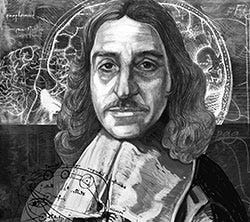
The father of modern neuroscience, Thomas Willis, identified his research as an examination of “the Pandects [or laws] of Nature, as into another Table of the Divine Word, and the greater Bible: For indeed, in either Volume there is no high point, which requires not the care, or refuses the industry of an Interpreter; there is no Page certainly which shews not the Author, and his Power, Goodness, Trust, and Wisdom.”2 Scripture reveals God, yes. But, if God made the world, then it is only to be expected that the world would display God’s character (and thus God’s power, goodness, faithfulness, and wisdom).
Earlier, in the twelfth century, theologian Hugh of St. Victor had written: “For the whole sensible world is like a kind of book, written by the finger of God … and each particular creature is somewhat like a figure … instituted by the divine will to manifest the invisible things of God’s wisdom” (Didascalion 7.4).
For our predecessors, this perspective on the natural order is rooted in words like these from Paul: “This is because what is known about God should be plain to them because God made it plain to them. Ever since the creation of the world, God’s invisible qualities—God’s eternal power and divine nature—have been clearly seen, because they are understood through the things God has made” (Rom 1:19–20, CEB). Long before Paul, the psalmist had declared: “Heaven is declaring God’s glory; the sky is proclaiming his handiwork” (Ps 19:1, CEB). Paul’s sentiment is expanded in Catholic and Orthodox Bibles: “All humans who don’t know God are empty-headed by nature. In spite of the good things that can be seen, they were somehow unable to know the one who truly is. Though they were fascinated by what he had made, they were unable to recognize the maker of everything” (Wis 13:1 CEB).

Jesus speaks similarly. Flowering plants and wild birds—aren’t these lessons about God’s gracious care for God’s creation, including God’s people (Matt 6:25–34)? In short, even if God’s self-disclosure reaches ultimate expression in Jesus Christ, we can still recognize God’s fingerprints, so to speak, throughout the cosmos.
Study of God thus encompasses exploration of all testimony to God’s character and design. This includes study of God’s two books, both of them: Scripture and the natural world.
We take science seriously, then, because our theology of creation demands it.
This essay continues after these book recommendations.

James K. A. Smith and Michael L. Gulker, eds., All Things Hold Together in Christ: A Conversation on Faith, Science, and Virtue (Grand Rapids: Baker Academic, 2018). ISBN: 9780801098987. 400 pp.
Leading philosophers, theologians, and historians write about the role of Christian practice in forming virtues, the role of virtues in forming intellectual discourse, and the role of Christology in forming our understanding of science and creation. This collection is less a point-by-point treatment of science-faith debates than a summons to methodological reorientation—arguing that how Christians disagree matters a great deal.

Andrew B. Torrance and Thomas H. McCall, eds., Knowing Creation: Perspectives from Theology, Philosophy, and Science (Grand Rapids: Zondervan, 2018). ISBN: 9780310536130. 352 pp.
The editors offer a cross-disciplinary resource that voices a positive account of a Christian theology of creation, drawing on a range of perspectives to examine a holistic picture of the natural world as God’s creation. Together, these essays demonstrate how productive engagement between classical Christianity and contemporary scientific investigation can be.
(2) More on the Inseparability of Science and Scripture
That Scripture and science are inseparably related is true for additional reasons, too.
On the one hand, we are incapable of coming to Scripture without bringing with us our assumptions about the world. Readers of the Bible have always read the Bible from within their own scientific understandings. This is true even though our understandings of the natural world have shifted.
On the other hand, ancient scientific views can be found in the Bible itself, as the biblical writers drew on then-contemporary understandings of the natural world to speak of God and God’s engagement with the world.
It seems obvious, then, that the question is not whether science will be taken into account, but rather: Which science? Whose science? So here’s the question: Will we allow certain scientific perspectives on the natural world to parade as “timeless truths”; or will we continue to study and learn from the natural sciences?
Let me give one example. In Luke 11:34–36, we hear these words from Jesus:
Your eye is the lamp of your body. When your eye is healthy, your whole body is full of light. But when your eye is bad, your whole body is full of darkness. Therefore, see to it that the light in you isn’t darkness. If your whole body is full of light—with no part darkened—then it will be as full of light as when a lamp shines brightly on you. (CEB)
What might this mean?
This much is clear: Jesus uses darkness / light as metaphors of ethical life. In order to press further, though, we need some background in ancient ophthalmology. Until the Late Middle Ages, two views were championed.
Extramission, the view Jesus assumes, was also held by Plato and Galen, who regarded the eyes as channels for the release of the body’s own light. For them, vision results from light rays emitted by the eyes. Imagine that the eye is like a flashlight. A good eye radiates good light whereas a poor eye radiates bad light (or no light at all).
Intromission, Aristotle’s view, holds that eyes detect light from outside the body and serve as the first stage in visual perception. Eyes receive rays rather than directing them outward. Book of Optics, written by the Arab polymath, Ibn al-Haytham (ca. 965–1040), and translated into Latin in the early thirteenth century, demonstrated the accuracy of this view, a position later confirmed in the West by Johannes Kepler (1571–1630).
So Jesus’s words reflect the earlier view of Plato, the view later held by others, such as Galen, Ptolemy, Augustine, and the early Da Vinci: extramission. Jesus pictures the eyes as channels that direct the body’s light outward. The critical question, then, is whether the eyes are sick or healthy, for this tells us whether a person is full of darkness or full of light.
Here’s the point: As Luke tells the story, Jesus uses a once-popular eye-science to characterize faithful life. We can learn from this message even when we’ve discarded its scientific understanding. (Actually, this message makes good sense when understood within this ancient physiology.)
In Luke’s Gospel, using a now-obsolete ophthalmology, Jesus identifies a sick eye as a signpost to inner darkness and a healthy eye as evidence of inner light, and this illustrates for us how biblical texts—and not only biblical interpreters—are implicated in scientific understanding.
Needed…
For Christ-followers, science and Scripture are not separate “things,” but are thoroughly entangled theologically and hermeneutically. What the church needs, then, are people, lay and clergy, more and more of them, who refuse to imagine that Scripture and science serve incompatible interests or that Scripture and science occupy non-overlapping worlds, and who work with discernment to think science and faith together. After all, Scripture itself presents the natural world as God’s good creation and commends the cosmos as a means to understanding something about God, God’s character, and the shape of faithful response to God.
Additional Resources
Biologist Darrell Falk’s Substack: “Reflections on faith, science, and harmony/disharmony questions from a lifelong biologist and Christian thinker.”
BioLogos “explores God’s Word and God’s World to inspire authentic faith for today. Our vision is faith and science working hand in hand.”
The American Scientific Affiliation: “An international community and fellowship of Christians engaged in the interface of vital faith-science questions.”
This classic taxonomy is found in Ian Barbour, When Science Meets Religion (New York: Harper, 2000).
Thomas Willis, The Anatomy of the Brain and Nerves (Birmingham: McGill-Queens University Press, 1978 [1681]), 51–52.
A hearty yes to these recommendations. The “conflict” model is both wrong and harmful. We should see science and faith as offering complementary angles on truth, and reject attempts to make Scripture answer questions the inspired writers were not addressing. Or to make science answer questions of purpose and meaning that it is not capable of addressing.
If you will forgive a little plug, I recently published a short book along these lines aimed at the average person in the pew:
https://a.co/d/0cRMnJpE
Science and the Sacred by Pearce and Clayton also is quite good.