
"He Descended into Hell"?
The Triumph of Christ

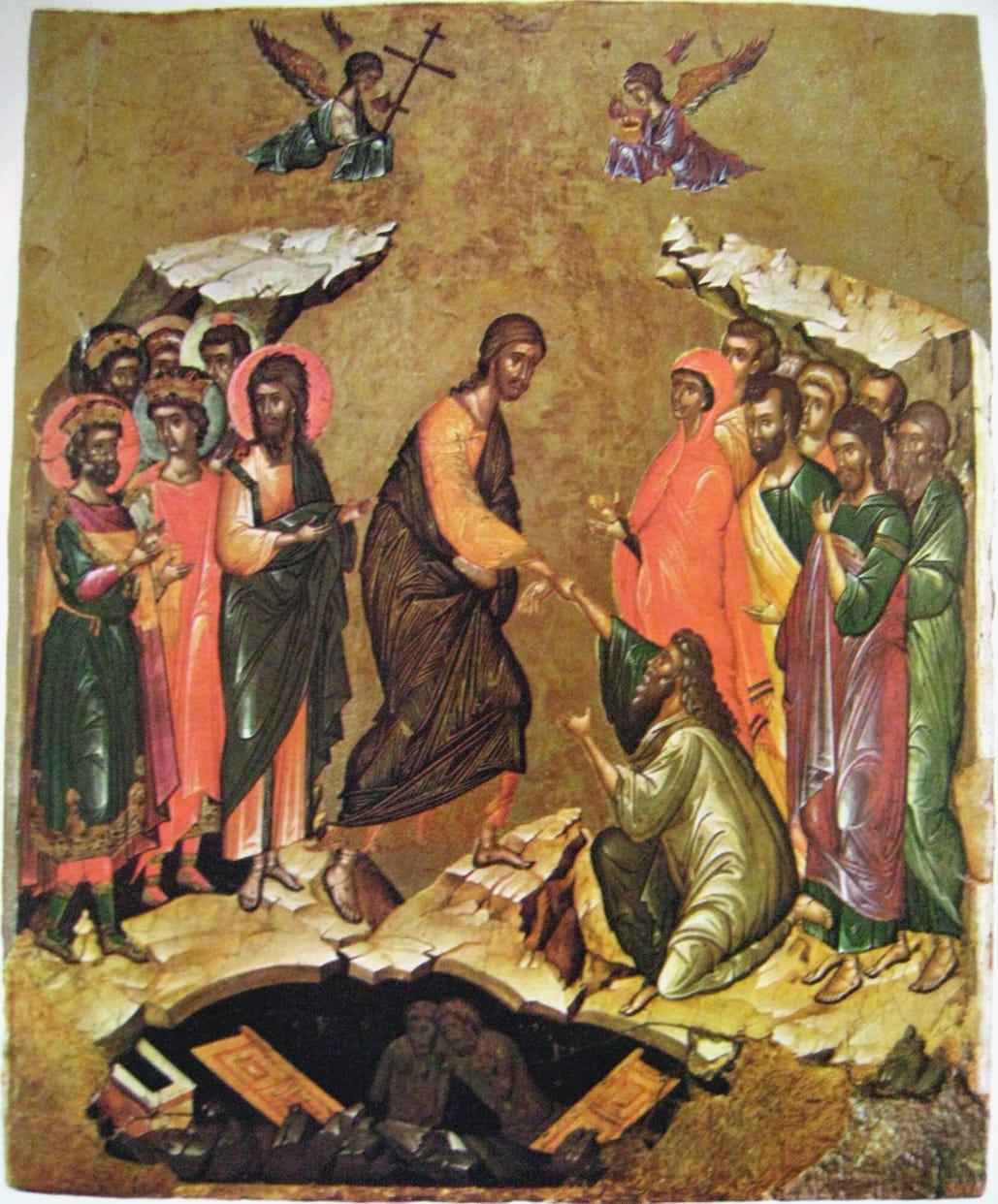
A brief clause in the Apostles’ Creed has quietly disappeared from a number of Sunday morning confessions. Some congregations simply skip over it. Others have revised their liturgical texts to omit it entirely. It’s short, but weighty: “He descended into hell.”
What are we to make of this phrase? For some, it’s puzzling, maybe even embarrassing. It sounds mythological, maybe even fanciful, the sort of thing we might want to translate into something more manageable, or perhaps set aside altogether. For centuries of Christian interpretation, though, this clause was a confession to celebrate. It identified something significant about who Christ is and what his death and resurrection accomplished.
What would would it look like to take this affirmation seriously?
1 Peter 3:18–22: The Textual Puzzle
The theological tradition concerned with Jesus’s descent into hell drew on a number of New Testament texts.1 Here, I focus on 1 Pet 3:18–22—which, by any standard, seems peculiar:
This is because Christ also suffered for sins, once for all, the Righteous One for the unrighteous ones, in order that he might lead you to God, having been put to death as a human but made alive by the Spirit—by whom he also went and preached to the spirits in prison, since they were disobedient back when the patience of God waited in the days of Noah as the ark was being constructed, in which a few people (that is, eight persons) were saved through water. The counterpart, baptism, now saves you—not as a removal of the stain of the flesh but as a pledge of a good conscience to God—through the resurrection of Jesus Christ, who, having gone into heaven after angels and authorities and powers were made subordinate to him, is at the right hand of God. (1 Pet 3:18–22 AT)
Peter writes that Christ, after his death, “went and preached to the spirits in prison, since they were disobedient.” A few verses later, he refers to “the dead”: “For this reason the good news was proclaimed to the dead, that having been judged as humans according to human standards, they might live by the Spirit according to divine standards” (4:6 AT). Who are these “spirits in prison”? Who are “the dead”?
Scholars have written extensively on the source of Peter’s imagery. Behind 3:19, most interpreters detect the influence of the Book of the Watchers, an early Jewish elaboration of Gen 6:1–4 (1 En. 1–36), likely composed in the third or early second century BCE. In this tradition, the “sons of God” who consorted with human women are recast as fallen angels—the Watchers—who brought corruption on the whole earth and were condemned by God to cosmic imprisonment: “You shall remain inside the earth, imprisoned all the days of eternity” (1 En. 14:5). Peter’s reference to “spirits in prison” almost certainly echoes this tradition.
However intriguing the source issue might be, the more pressing question for us is theological: What does Peter do with this material? Answer: He takes a story about cosmic powers under divine condemnation and transforms it into a proclamation of Christ’s universal lordship, with Christ asserting his sovereignty over every realm of existence, even the underworld. So while the source-question is interesting, it’s the theological question that pushes us to explore, and reflect on, what Peter is doing.
Christus Victor: The Triumph of Christ
Among the myriad ways we have learned to think about the atoning significance of Jesus’s death, we find an ancient, model: Christus Victor, Christ the Conqueror. Here, the cross and resurrection are understood in terms of cosmic triumph. Christ enters into the full depth of the human condition, including death itself, and defeats from within the powers that hold humanity captive—death, hell, and all other forces aligned against God’s purposes. It’s this model of the atonement that we see at work in 1 Pet 3.
The New Testament bears witness to this atonement model in a variety of ways. For example, Paul writes that Christ must reign “until he puts all enemies under his feet” (1 Cor 15:25; citing Ps 110:1). Elsewhere, he envisions every knee bowing “in heaven, on earth, and under the earth” (Phil 2:10). Peter’s own language in 3:22—that “angels and authorities and powers” have been subjected to the exalted Christ—breathes this same air.
C. S. Lewis offers an unforgettable illustration in The Lion, the Witch and the Wardrobe. Aslan, slain on the Stone Table, returns to life, and immediately runs to the Witch’s stronghold—that courtyard full of statues, creatures she has turned to stone—and breathes on them, restoring them to life. Then he searches the house itself, “in every nook and cranny,” because, as Lewis puts it, “you never know where some poor prisoner may be concealed.” This is what Lewis called “the ransacking of the Witch’s fortress,” and it is a narrative enactment of what the tradition of Christ’s descent into hell has persistently claimed: Christ’s victory is cosmic and comprehensive, reaching into every corner of captivity.2
The Cloud of Witnesses
Given contemporary reticence to talk of Jesus’s descent into hell, it’s striking how naturally and how early this interpretation took hold in the church.
From the turn of the second century, the Odes of Solomon (among our earliest hymnic texts written by Christ-followers) returns repeatedly to the image of Christ’s descent. Ode 42 is particularly vivid:
Sheol saw me and was shattered,
And death ejected me and many with me.
I have been vinegar and bitterness to it,
And I went down with it as far as its depth.
Then the feet and the head it released,
Because it was not able to endure my face.
And I made a congregation of living among his dead;
And I spoke with them by living lips;
In order that my word may not be unprofitable.
And those who had died ran towards me;
And they cried out and said, “Son of God, have pity on us.
“And deal with us according to Thy kindness,
And bring us out from the bonds of darkness.
“And open for us the door
by which we may go forth to you,
for we perceive that our death does not touch Thee.
“May we also be saved with you,
because you are our Savior.”3 (42:11–18)
Around 167 CE, Melito of Sardis writes of Christ’s declaring: “Who is my opponent? I, he says, am the Christ. I am the one who destroyed death, and triumphed over the enemy, and trampled Hades under foot, and bound the strong one, and carried off man [sic] to the heights of heaven. I, he says, am the Christ” (On the Passion 102).
In fact, the idea of postmortem proclamation and even postmortem conversion is not as rare among early Christ-followers as we might think. In the Shepherd of Hermas, written in the first half of the second century and enormously popular in the second and third centuries, we read:
When these apostles and teachers who proclaimed the name of the Son of God died in the power and faith of the Son of God, they delivered their proclamation even to those who had died previously and gave them the seal of the proclamation. So they wend down with them into the water and again rose up from it. And these went down living and rose up living. But those who died before went down dead, and rose up living” (Parables 9.16.5–6, LCL).
Also from the early second century, the apocryphal Gospel of Peter recounts in the immediate aftermath of the resurrection: “And they [i.e., the Lord and the two assisting him out of the grave] heard a voice out of the heavens crying, ‘Hast thou preached to them that sleep?’, and from the cross there was heard the answer, ‘Yea’” (10:41–42).4 1 Cor 15:29, that notorious passage regarding “baptism for the dead,” is susceptible to a similar reading.
And there’s still more…
Clement of Alexandria, reflecting on those who died before the gospel was proclaimed, asks pointedly: Would it not be an “extraordinary arbitrariness” for such persons to be condemned without ever having had the opportunity to hear and respond? His answer is that Christ’s descent ensures the impartiality of divine judgment. No one, not even the dead of ages past, stands outside the reach of the good news (Strom. 6.6).
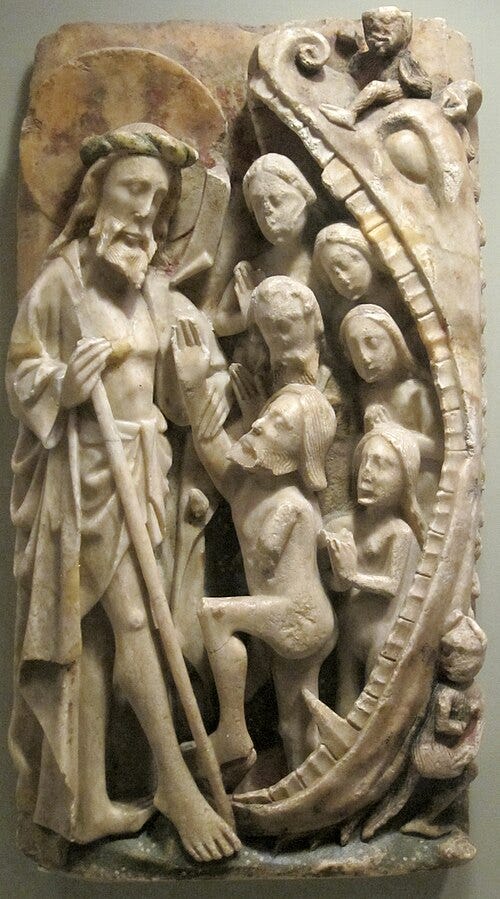
The tradition isn’t only literary. Byzantine iconography developed a distinctive image for Easter morning—the anastasis, the resurrection—that doesn’t depict an empty tomb. Instead, it depicts Christ descending into Hades, grasping Adam and Eve by the wrists and pulling them upward out of their coffins, with the gates of death shattered beneath his feet.5
The eleventh-century commentator Theophylact of Ohrid made an astute observation about his predecessors who read 1 Peter “out of context.” He argued that it was precisely attention to context that demanded the traditional reading: “The ‘dead’ are those who have been shut up in hell, to whom Christ went to preach after his death on the cross.”6 In other words, Theophylact didn’t regard this reading as fanciful speculation or as an imposition on the text; rather, it reflected serious engagement with 1 Pet 3.
This is what the church saw when it looked at Easter: a liberation of cosmic proportions.
What Does This Tradition Claim?
We need to be clear about what this tradition is asserting: It’s an affirmation that Christ’s lordship is genuinely universal, that his victory over death extends to every realm of existence, and that the impartiality of God’s judgment holds even for those who died without hearing the gospel.
Peter’s own summary captures it well. Christ has gone “gone into heaven after angels and authorities and powers were made subordinate to him, is at the right hand of God” (3:22). The movement is complete—from death, to proclamation in the realm of the dead, to resurrection, to exaltation above every power that exists. As Paul affirms elsewhere: “This is why Christ died and lived: so that he might be Lord of both the dead and the living” (Rom 14:9).
And so?
Recovering this tradition has ongoing importance for Christ-followers.
First, it situates present suffering within a cosmic conflict whose outcome has already been decided. Peter’s audience included people on the margins: socially vulnerable, subject to suspicion and slander, living in the uncomfortable borderland between their faith and their world. What Peter offers them is a reorientation, as if he were saying: You aren’t victims. You participate in a battle already won. The “powers” that animate social hostility and coercive force have been made subject to Christ. This doesn’t mean they have ceased to be active (Peter will warn in the very next chapter about the adversary prowling like a roaring lion), but that their hostility isn’t ultimate; it doesn’t have the final word.
Second, it insists on the comprehensiveness of God’s redemptive purpose. A Christ who descends to the dead is a Christ whose reach is not limited by geography, history, or the accidents of human mortality. This should make us more expansive in our theology, more humble in our judgments, and more confident in our witness.
Third, it reminds us that the good news is bigger, more expansive, than our sometimes-domesticated versions of it might suggest. The clause that makes some of us uncomfortable—“he descended into hell”—actually promotes something about the boldness of our faith: This God-in-Christ went into the uttermost depths of despair and oblivion, all authorities are made subject to him, and he sits at God’s right side. He is, indeed, Lord of all.
What follows is adapted (much-abbreviated!) from Joel B. Green, 1 Peter, Two Horizons New Testament Commentary (Grand Rapids: Eerdmans, 2007). Unless otherwise noted, biblical citations follow the Common English Bible.
C. S. Lewis, The Lion, the Witch and the Wardrobe (New York: Collier, 1956), 142–74 (quotations from 160, 167, 168).
ET in J. H. Charlesworth, “Odes of Solomon,” OTP 2:771.
ET in Christian Mauer and Wilhelm Schneemelcher, “Gospel of Peter,” in New Testament Apocrypha, 2 vols., by Edgar Hennecke, ed. Wilhelm Schneemelcher, rev. ed. (Philadelphia: Westminster, 1991), 225.
See Heidi J. Hornik and Mikeal C. Parsons, “The Harrowing of Hell,” BRev 19 (2003): 18–26, 50; Frederic W. Farrar, The Life of Christ Represented in Art (New York: Hodder & Stoughton, 1894), 433–37.
ET in James, 1-2 Peter, 1-3 John, Jude, ed. Gerald Bray, ACCNT 11 (Downers Grove, IL: InterVarsity, 2000), 114.
Such a wonderful article ! Thankyou for writing it ! Christ is risen hallelujah
Great! Just fab! I wonder if the deletion of the "hell" phrase isn't generally related to disbelief in the spiritual realm. After an Easter message I preached, I had a fellow pastor in town contact me and say " That was a pretty good Easter morning message, I just wish you wouldn't insist on the actual physical resurrection."