
Living in Empire
The Soft Resistance of 1 Peter (3)

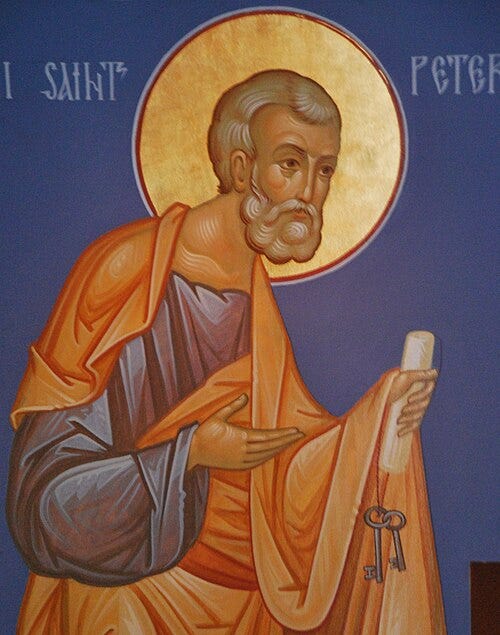

What does resistance look like when you have no army, no vote, no institutional standing, and no realistic prospect of changing the structures that oppress you?
That’s not a hypothetical question. It’s the situation of the Christ-followers to whom Peter writes—scattered across the Anatolian Peninsula (modern-day Turkey), a small minority of aliens and strangers in a world shaped by Roman power, exposed to social hostility and occasional violence.
First Peter has a reputation as a “compliant” New Testament letter—one that tells Christ-followers to submit to governing authorities, to “try to get along.” That reputation is undeserved. In fact, 1 Peter turns out to be a politically serious document: one that challenges the empire’s story, subverts its language, and proposes a different account of what honor, power, and faithfulness look like. In this three-part series, I make the case for a different reading—beginning with the standard interpretation and why it falls short (Part One), moving through the models that have distorted our reading (Part Two), and arriving at what I’m calling the quiet subversion at the heart of Peter’s letter (Part Three).
Here are Parts One and Two. This is Part Three.
What does faithfulness look like in that situation?
One way to answer that question is to pay attention to what scholars today sometimes call “hidden transcripts”—the quiet, often unnoticed ways in which marginalized peoples maintain their identity and resist the dominant order without ever staging an open revolt.1 Alongside the “public transcript” (what the powerless say and do in the presence of power) runs a different script, carried in language, in story, in alternative practices, in refusals so quiet they can be missed entirely.
Read this way, 1 Peter turns out to be a more politically interesting document than it first appears.
Plotting Time: Whose Story Are You Living In?
The first form of quiet resistance in 1 Peter is narrative-based. Peter is doing something that looks, on the surface, like simple pastoral encouragement. He’s reminding his audience who they are. But identity formation isn’t merely devotional. It’s also political, because the story we inhabit determines what we are able to imagine, what we can endure, and what we refuse.
Daniel Smith-Christopher, reflecting on the experience of exile, observes that “a significant strategy of creativity in exile is to do critical historiography.”2 He’s not talking about the fabrication of convenient myths, but the insistence on narrating events differently. He’s talking about the need to recognize that there are multiple ways of construing what has happened, that narrative is often the best weapon of the powerless, and that history-writing is fundamentally about shaping identity.
Peter is doing exactly this.
What’s remarkable is the combination of Peter’s obvious concern with establishing the identity of his audience and his failure to do so on Roman terms.
He locates his audience within the grand story of God’s agenda—before creation, in the story of Israel, in the life and death and resurrection of Christ, through the outpouring of the Spirit, and within the eschatological horizon toward which all of this moves. Within that story, the “eternal glory of Rome” is relegated to what it actually is: a short-term, interim arrangement. The empire that looks permanent and total from the inside is, from Peter’s angle, a passing frame in a much larger drama.
This isn’t wishful thinking. It’s a competing historiography, and it requires courage to maintain it—especially when Roman imperial ideology was inscribed everywhere, from coins to temples to the calendar itself. To narrate life differently is to resist the empire’s account of reality, quietly but persistently, every day.
Playful Language: Whose Words Are You Using?
A second form of resistance is lexical. Words, Peter seems to understand, are never neutral. They carry worlds with them. And the world we inhabit is partly constituted by the words available to us.
The violence Peter’s audience is experiencing is, he notes, primarily verbal—slander, accusations, public shaming. Words are the weapons being used against them. So it matters enormously which words they use in return.
Words do things, so we ought to pay attention to what Peter does with some of the most charged terms in Roman imperial culture.
Lord: In 1 Peter, this word refers to Jesus. Not to Caesar, not to local patrons and benefactors to whom social obligation would be owed, not to any human authority at all. Jesus is Lord. The word hasn’t been abandoned; it has been reassigned.
Fear: In the Roman world, fear was a tool of social control. The fear of shame, of violence, of losing one’s standing. For Peter, fear is something else entirely. It’s more like reverent awe before God, a fundamental orientation of one’s whole life toward the one to whom ultimate allegiance belongs. When God is the one you fear, the things the empire uses to frighten you lose their grip.
Judgment: Rome judged. Courts judged. Patrons judged. Honor and shame were the currency of a society in which one’s standing was always being evaluated by one’s betters. But Peter insists that judgment belongs to God, that God’s canons are unaffected by human calculations of status, that God “shows no partiality”—that is, God doesn’t “acknowledge the face,” isn’t swayed by the indices of prestige that Roman society took for granted. Unlike human courts and the courts of social opinion, God judges justly. That’s a quiet but devastating critique of the entire Roman system, rooted as it was on who had power and privilege.
Endurance: This word could easily be heard as passivity, as patient suffering, as bearing what cannot be changed. Peter means something stronger: unyielding perseverance, courageous steadfastness in the face of opposition. Active, not passive. Determined, but nonviolent. Not revolutionary, but nonetheless subversive.
Taken together, these words, and others besides, inflect normal usage in ways that are unobtrusively subversive. They look like ordinary language. They sound, on the surface, perfectly acceptable. But they are quietly evacuating imperial vocabulary of its content and filling it with something else.
This essay continues after this book notice. [Note: As an Amazon Associate, I may earn a small commission if you click through and make a purchase. This doesn’t affect the price you pay and helps support this website.]

Joel B. Green, 1 Peter, Two Horizons New Testament Commentary (Grand Rapids: Eerdmans, 2007). ISBN: 9780802825537. 345 pp.
This series on “the soft resistance of 1 Peter” is an abridged form of an essay from the “Theological Horizons” section of this commentary.
Doing Good and Receiving Honor: Whose Standards?
A third form of resistance is perhaps the most socially penetrating. That’s because it strikes at the deepest level of the culture: the conventions governing honor and shame.
In Peter’s world, honor wasn’t a vague aspiration. It was a taken-for-granted social currency, carefully regulated and universally understood. Where you stood in the hierarchy of status, who could claim what kind of honor, how you were expected to behave toward your superiors and inferiors, what counted as “doing good”—all of this was the stuff of lifelong formation, deeply internalized and enforced through social pressure that could be intense and unrelenting.
“Doing good” in this context connoted something like the performance of public benefaction by those with the wealth and standing to do so. It was a way of maintaining and advertising one’s position.
Peter consistently calls his audience to “do good.” Peter may sound entirely Romanish, but he actually fills this imperative with different content: Doing good is nothing other than holiness in every area of life, the performance of God’s will—regardless of what it costs in terms of social standing.
And honor? Peter’s audience is told that what matters is God’s valuation, not Rome’s. God arbitrates status. And God, Peter insists, isn’t swayed by the usual Roman indices of prestige sex, age, ancestry, landed wealth, or the status of one’s circle of friends. God accounts for faithfulness in response to the good news of Christ, full stop.
And that, in its social context, is a revolutionary claim. Not staged as a revolution—nothing here calls for an overthrow of the existing order. But at the level of what actually forms people, what actually shapes desire and aspiration and the sense of what matters… Peter is proposing a complete reorientation.
The Amphibious Life
What Peter calls his readers to is, finally, an essentially amphibious existence. They aren’t a “third race,” neither Jewish nor gentile. Their feet are planted in the culture around them, and yet they are, in some fundamental sense, outsiders to that culture. Their difference is “internal to the culture.”3
They are bicultural, living between two worlds, with the one a source of tension with the other. How they choose to live in that tension, and whether they choose to resolve it by fully withdrawing from one in favor of the other, is the issue to which Peter devotes himself. For this reason, it’s impossible to imagine that Peter’s theological strategy could be reduced to a concern either for internal cohesion or for external separation.
Following the Christ who was crucified on a tree determines both internal and external relations; it is a profoundly political and missional act (external) and a commitment to indwelling a terrain determined by the sanctifying Spirit and intramural hospitality (internal). The homeless people of God that is a temple (rather than a people that has a temple home)—this is a people of God under construction and a priesthood whose vocation it is to mediate God’s presence wherever they find themselves (2:4–10).
That pattern, internalized, becomes a kind of embodied history—operative at a preconscious level, giving rise to practices that are genuinely responsive to each particular situation rather than mechanically applied from a template.
Peter isn’t asking his audience to accommodate to Roman society, nor to withdraw from it. He is asking them to go on writing the next chapter of the Israel-Christ story—empowered by the Spirit to maintain their allegiance to the merciful Father by journeying through suffering in hope of eschatological honor and, so, bearing witness to the coming of the new age.
Which turns out to be exactly what he’s asking of us.
See, e.g., the classics: Michel de Certaeu, The Practice of Everyday Life (Berkeley: University of California Press, 1984); James C. Scott, Domination and the Arts of Resistance: Hidden Transcripts (New Haven: Yale University Press, 1990).
Daniel L. Smith-Christopher, A Biblical Theology of Exile, Overtures to Biblical Theology (Minneapolis: Fortress, 2002), 200.
Miroslav Volf, Exclusion and Embrace: A Theological Exploration of Identity (Nashville: Abingdon, 1996), 49; original in italics.
Thanks for this, Professor Green. What a powerfully relevant message for us in today’s modern form of empire. Telling different stories, infusing words with different meanings, ascribing value in different ways, carrying a different identity, bearing witness to a different kingdom, even as we live in this one. Profound and inspiring.